The Gemmological Institute of America or GIA as it is better recognised. Are the most well known and reputable laboratory in the world.
The GIA diamond grading report provides a careful evaluation of the diamonds characteristics. The report will illustrate the position, size and shape of every inclusion and blemish that the diamond possesses.
GIA are very strict in assessing the colour and clarity grade of every diamond. If a diamond is border-line between two grades GIA will usually assign the lower grade. This is so the diamond will not be over evaluated.
 GIA certified diamond reports will provide information of the shape, measurements, weight and percentages of the depth and table of the diamond. The most important factor to look out for is the cut, polish and symmetry of the stone. These are graded from a scale ranging from poor to excellent.
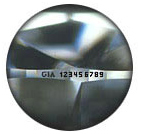
GIA has recently added a new Dossier certification; this is a miniature version of the standard full GIA diamond quality report. This report does not provide the plot that shows inclusion and blemishes. However the majority of GIA certificated diamonds have a laser inscription on the edge of the girdle. This can be used for identification purposes so that you know your diamond matches with your certificate.

The colour grading scale will determine a diamonds colour. Light source and background can have a significant impact on the appearance of colour. The diamond's colour is graded in a standardized viewing environment. Colour graders submit their independent opinions into the system. During this phase, graders are not shown the colour opinions entered previously. The colour grade is determined when the opinions are agreed. The colours can range from D which is colourless through to Z which is yellow. Diamonds that are graded after Z are classed as fancy yellow.

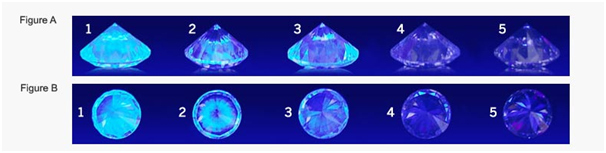
When grading diamonds fluorescence, an ultra violet light is shone upon the diamond. This will show what type, if any fluorescence that the stone has.
Diamonds that are said to be fluorescent contain particles that emit a visible (usually blue) glow when exposed to UV lighting. In rare cases, high levels of fluorescence can make stones appear milky or hazy, although for the most part fluorescence does not generally impact beauty or sparkle and can even make some lower colours (I, J, K, L, etc.) appear more colourless or white. Nonetheless, fluorescent diamonds are usually cheaper and provided the effect is not readily visible may offer good value for money.