
IGI is the International gemmological institute and is the largest organization of its kind, with offices all over the world.
IGI believe that a diamonds beauty is the result of natural aspects of the rough crystal combined with the finished quality of the cutting and polishing process.
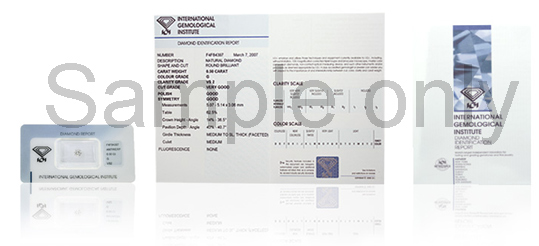
Diamonds and gemstones of similar appearance can have important differences in value. Even experts need powerful analytic tools to detect synthetics, treatments and enhancement processes. An IGI certificate clearly discloses the details of any item it accompanies, providing confidence for both buyer and seller.
An IGI certificate will tell you the carat, colour, clarity and cut of your diamond.
The weight or size of a diamond is measured in carats (ct). One carat weighs 1/5 of a gram and is divided into 100 points, so a diamond weighing 1.07carat is referred to as one carat and seven points.
It is important to note that diamonds of the same weight don't necessarily have the same size appearance. Those cut too shallow or deep may look small for their weight, or suffer in brilliance. IGI recommends the diamond size chart below to use as a guide for diamond size.

When diamonds are mined, large gems are discovered much less frequently than small ones, which make large diamonds much more valuable.
Diamond prices rise considerably with carat weight. A- 2 carat diamond of a particular quality is always worth more than two- 1 carat diamonds of the same quality.
Diamonds vary in colour from completely colourless down to visible yellow or brown tint. The rarest and most expensive are diamonds in the colourless range, they are graded D,E and F on a scale.

To determine the correct colour, all submitted diamonds are compared to an internationally accepted master set of stones, the colours of which range from D, or colourless to Z which are yellow/ brown in colour. Diamonds with more intense colour than a Z are classed as fancy colours and would be graded using a coloured diamond scale.
IGI assigns a colour grade for diamonds in the D-Z range with the diamond face-down and viewed through the pavilion. This is because size, shape, cut quality and the presence of fluorescence can influence visible face- up colour. In fact, lighting, mounting choice and even the clothes one wears will have an impact on colour. IGI uses the most neutral environment possible to ensure accurate and consistent results.
IGI grading reports show plotted diagrams of clarity characteristics. There are two types of clarity characteristics: inclusions and blemishes. In order to grade the clarity of a diamond, it is necessary to observe the number and nature of external and internal characteristics of the stone, as well as their size and position. The difference is based on their locations: inclusions are enclosed within a diamond, while blemishes are external characteristics.
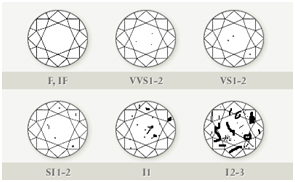
Whilst nature determines the colour and clarity of a natural diamond, man is responsible for the cut quality which brings it to life.
The planning, proportions, cutting precision and details of finish determine how brilliant and bright the diamond will be. If the diamond is not cut correctly, the appearance of the stone is affected.
Elements of a diamonds beauty can be described as brilliance, dispersion, fire and sparkle. These qualities combine to create the life of the diamond and the way it reacts to lighting and environment.
An IGI certificate will grade your diamonds cut, polish and symmetry. An ideal cut will create a very bright stone.